25 Remarkable Facts About The Galápagos Islands
Enjoy fun facts and interesting tidbits about the Galápagos Islands, a volcanic archipelago and one of the most biodiverse places on earth.
- By: Rebecca Braak
The famed Galápagos Islands are a treasure trove of natural wonders, famous the world over. Even many who have never been to this archipelago are aware that naturalist Charles Darwin based his Theory of Natural Selection on his travels here. However, what many may not know is that he only spent a mere five weeks in the Galápagos. Despite the relatively short stay, he made good use of his time.
Everyone also knows that these islands are a biodiversity hotspot, home to unique animals like waved albatrosses and giant tortoises. Yet another cool fact about the Galápagos is that 20% of the marine species here are endemic. That means certain animals, like marine iguanas and Galápagos penguins, can only be found on these “Enchanted Islands.” Below you’ll find 25 more facts to arm you with the info needed to ensure you make the most of any future Galápagos adventure.
Table of Contents
1. The Galápagos Islands are Nearly 100% Protected
A crucial fact about the Galápagos is that the archipelago, located off the coast of Ecuador on the equator, is protected as a national park. In fact, it was established in 1959 as Ecuador’s first-ever national park. It covers 97% of the land area and its endemic animals, with the reamining 3% inhabited by humans. Even the 76,448 square miles (198,000 sq km) of surrounding ocean is protected as a marine reserve (est. 1998), home to more than 3,000 aquatic species. The strict conservation of this archipelago is the reason it remains a biodiversity hotspot and center of scientific research and tourism.
2. The Galápagos is a UNESCO World Heritage Site
In 1978, the Galápagos Islands became the first-ever UNESCO Natural World Heritage site. The islands were recognized because of their unique plant and animal life, and several years later, in 1984, they were declared a UNESCO Biosphere Reserve. Then, in 2002, the wetlands on Isabela Island were declared a Ramsar Site. Also of note is that another Ecuadorian locale, the city of Quito, was chosen as the second-ever UNESCO site. In total, Ecuador has five properties inscribed on the World Heritage List (three cultural and two natural). They are:
- Galapagos Islands (1978)
- City of Quito (1978)
- Sangay National Park (1983)
- City of Cuenca (1999)
- Qhapaq Ñan, Andean Road System (2014)
3. These Volcanic Islands are Millions of Years Old
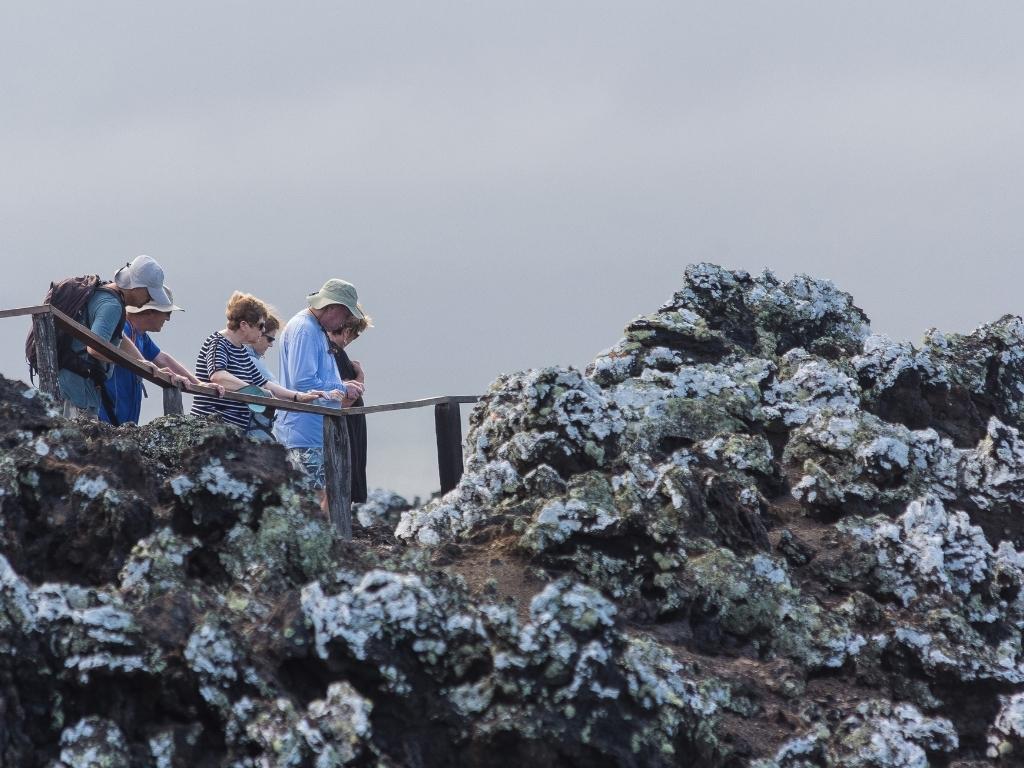
The Galápagos archipelago consists of 127 islands and islets. Of the total, 19 are considered large islands, and four are inhabited (Santa Cruz, San Cristóbal, Isabela, and Floreana). These islands are also volcanic, formed 3-5 million years ago due to activity on the Nazca tectonic plate. Also, according to scientist Kenneth Leonard, every island except for Isabela (the largest Galápagos island) was formed by a single underwater volcano!
4. Ocean currents converge in the Galapagos
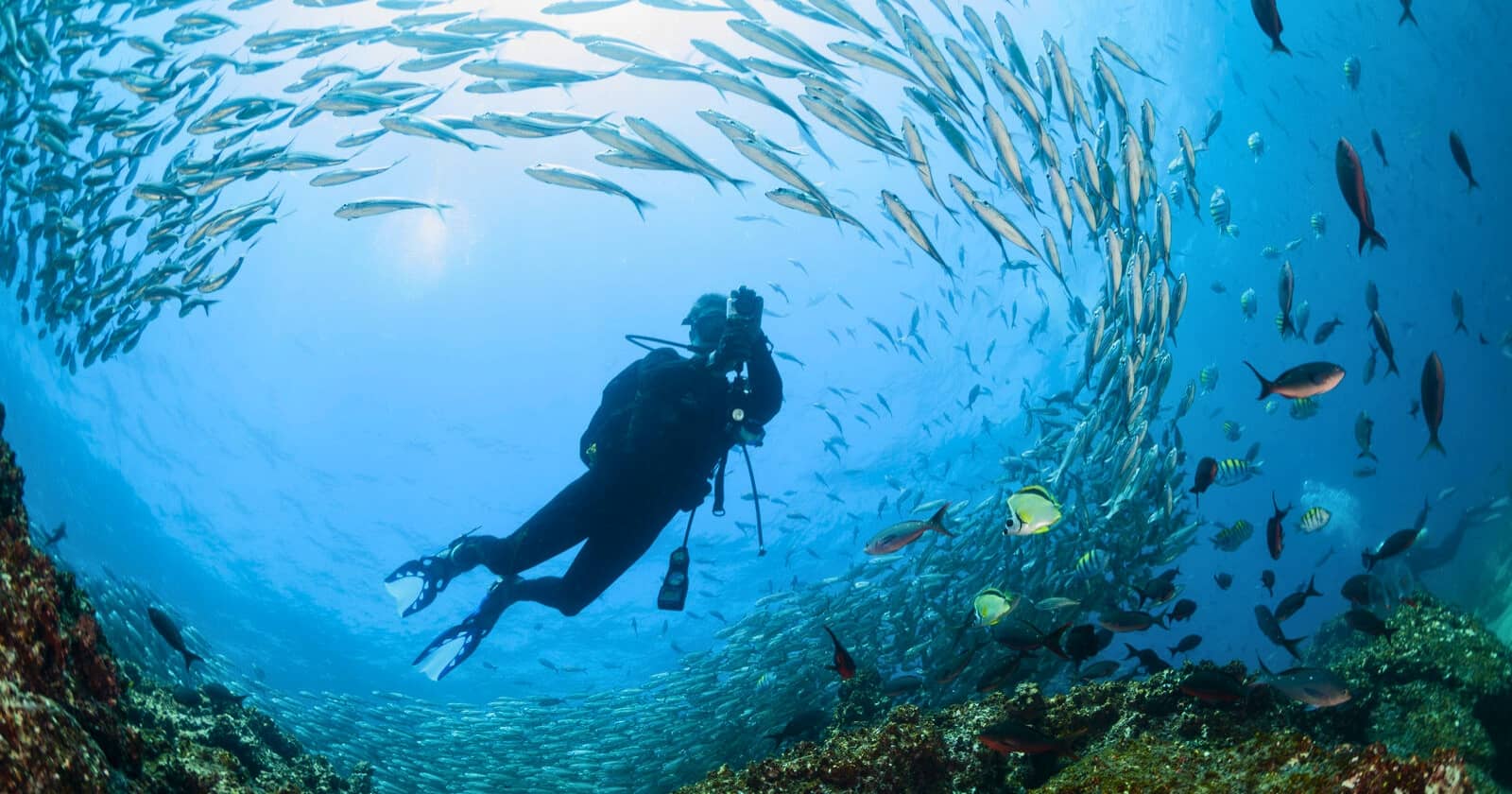
Ocean conditions are determined by the sea’s currents, and in the case of the Galápagos Islands, the currents define their marine ecosystems. For example, from June to December, the cool waters of the Humboldt Current flow up from Antarctica, creating ideal conditions to see penguins, orcas, albatrosses, and other endemic species. But this isn’t the only one; the Galápagos is home to a convergence of three different currents:
- Cromwell Current
- Humboldt Current
- Panama Flow
Where Humboldt meets Cromwell, they bring colder water with temperatures around 59°F (15°C) and great diving conditions. Even considering the colder water, the Galápagos weather is still considered subtropical.
5. There are Species in the Galápagos Found Nowhere Else on Earth
The Galápagos Islands are famous for their exotic animals. Wildlife lovers flock here because a majority of animals can only be found on these islands. Of the over 9,000 species of flora and fauna, 42% of the plants, 97% of reptiles and land mammals, 80% of birds, and 56% of insects are endemic. These include 600-700 native plant species and 14 endemic mammals like sea lions and rice rats. There are even 13-15 species of giant tortoises only found in the Galápagos.
In the waters of the Galápagos, 20% of marine life is endemic. For example, the marine Iguana and the Galápagos penguin (the only penguin species found north of the equator) only exist in this archipelago. The same is true with other pelagic species such as tunas, spotted eagle rays, golden rays, and hammerhead sharks.
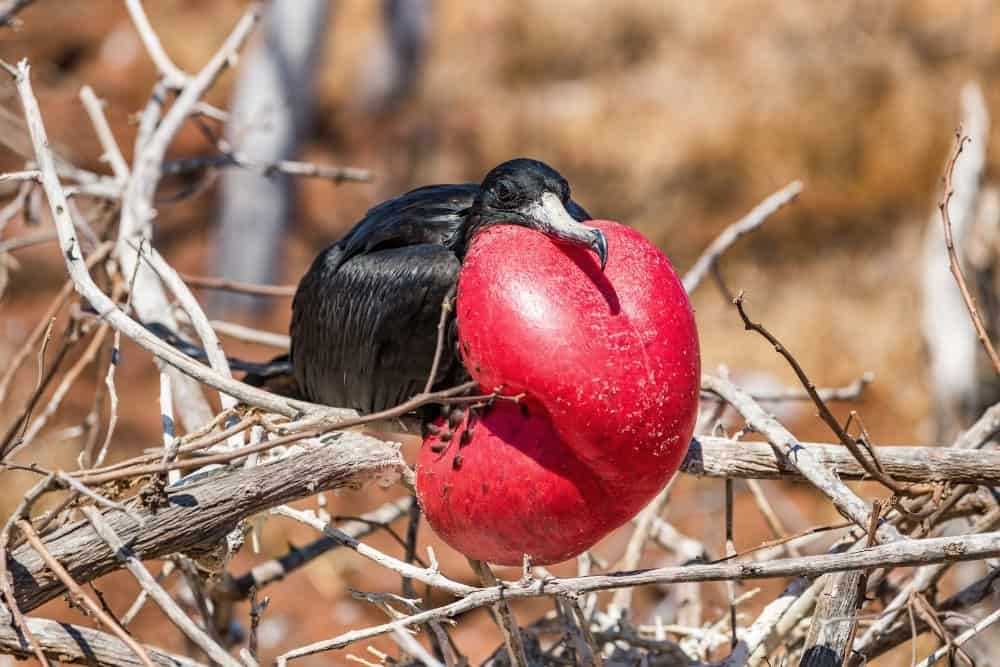
As for birds, there are 56 avian species native to the Galápagos. Of that total, 45 (80%) are endemic, and 11 are indigenous, which means they are native to the islands but can also be found in other parts of the world. The Galápagos has 29 resident land birds. Highlights include the Galápagos hawk and flycatcher, as well as owls, warblers, and cuckoos. Some of the most famous of all Galápagos birds are three species of boobie (red-footed, blue-footed, and Nazca), flightless cormorants, and the waved albatross. Taken together, this makes the Galápagos a paradise for birders.
6. There are Two Types of Seal in the Galápagos
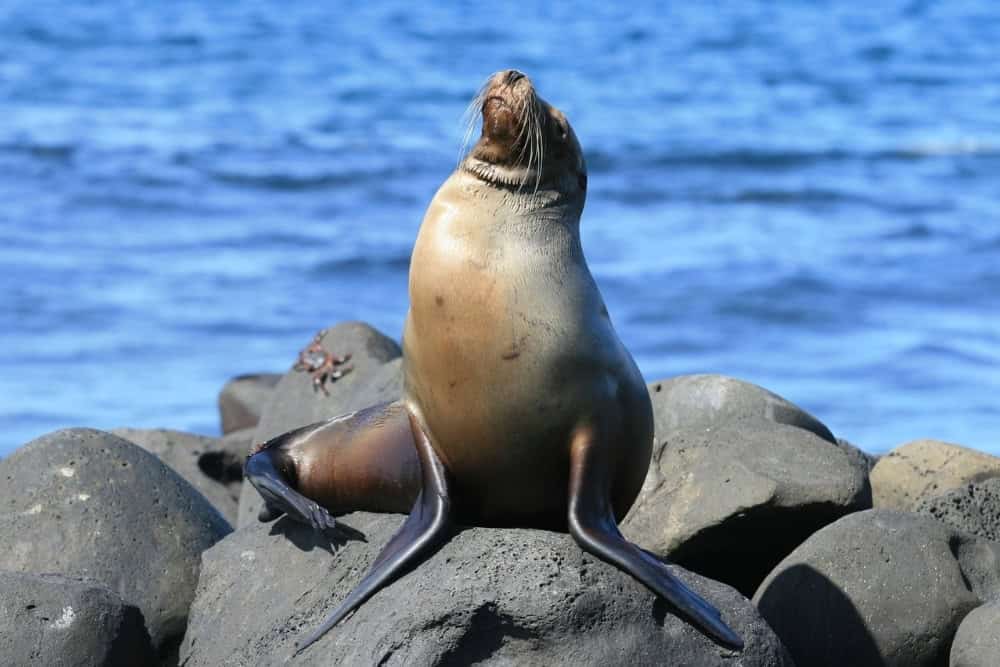
When you start your Galapagos vacation, probably the first animal you’ll encounter is a Sea Lion sleeping on the docks where tourists board cruises. Also, they like to swim around the shorelines. You’ll be able to see them play while you snorkel or dive.
Sea Lions
A fun fact about the Galapagos Islands is that, when they’re on land, Sea Lions congregate in harems. This means that a group of females assemble around a dominant male bull. However, female sea lions can move from harem to harem. It’s a bull’s job to defend the females from other males who want to come close. The job is so exhausting, that bulls only defend a harem for up to three months.
Female Sea Lions give birth to a single pup once a year. They stay with their newborn for five days. After that, she’ll leave him to go fishing. One female is in charge of watching over pups, while the other goes fishing. Sea Lion pups learn to fish when they’re five months old.
Fur Seals
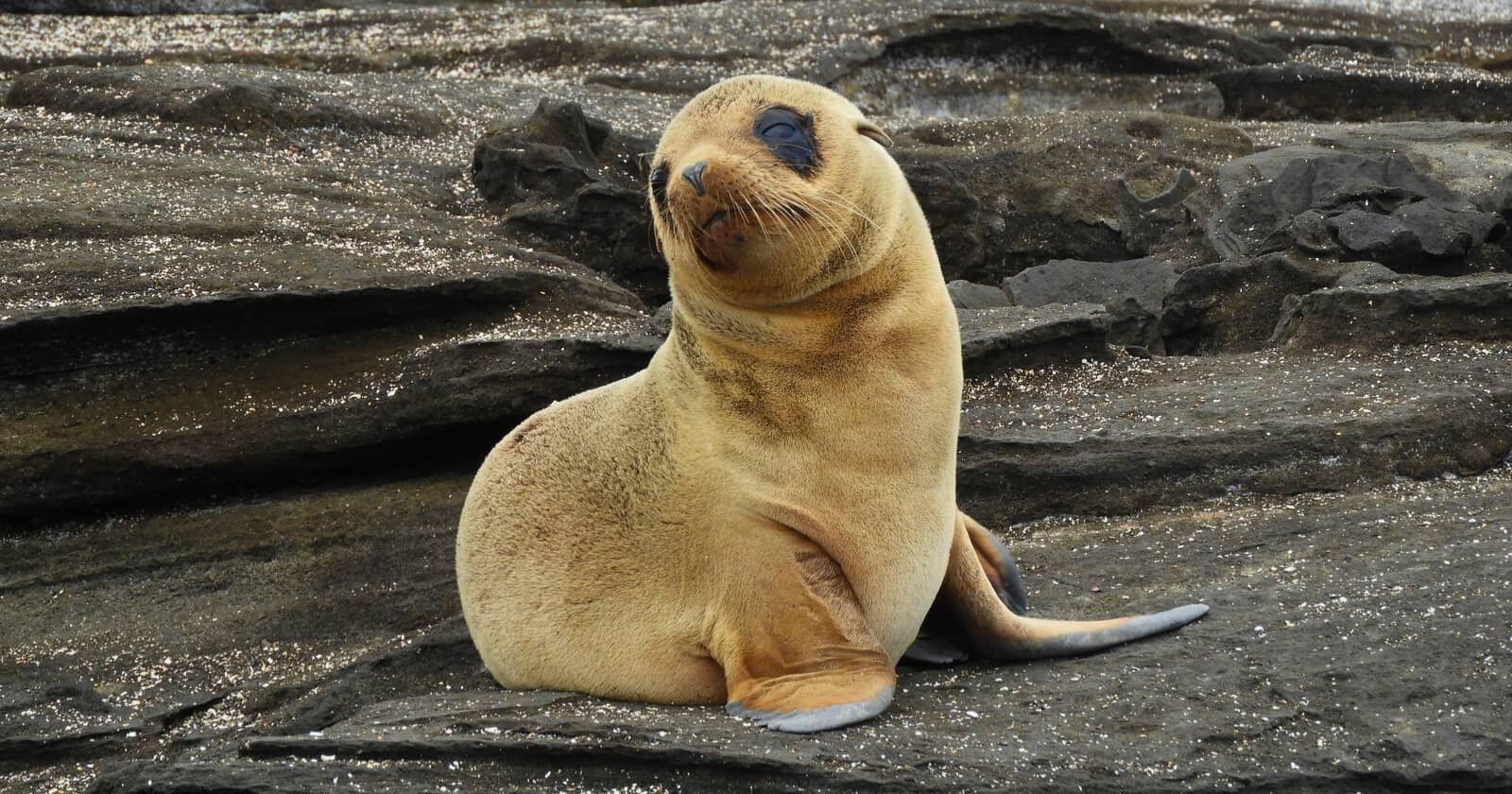
You probably didn’t know that there are Fur Seals in the Galapagos. Interesting facts about the Galapagos Islands include that even though Fur Seals look similar to Sea Lions, they are smaller and have shorter heads. Also, they prefer colder waters and shadier shores. Their name comes from their fur coat.
Fur Seals are nocturnal hunters. They prefer fish and squid. However, they prefer to stay on shore during a full moon, maybe to stay away from sharks!
7. Darwin’s finches can only be found in the Galapagos
There are 13 species of endemic Finches on the Galapagos. Finches are small land birds that diversified and adapted to the island’s different environments. They are known as Darwin’s finches, after Charles Darwin. Darwin analyzed their beaks, which evolved into different food types. If you want to differentiate the finches, check their beak size and shape:
- If the animal has slim, sharp beaks, they are an insect-feeding bird.
- If they have short, thick beaks, they are seed-eating populations.
Darwin’s finches have different shades and tones. Their plumage varies from black, brown, or olive. They have short tails and rounded wings. Even though it’s difficult to identify Finches just by the plumage, the color can help determine the male from the female. For instance, male Finches usually have black plumage, while females have brown plumage.
The simplest way to identify Finches is to check where they live. The medium tree Finch is endemic to Floreana Island, while the large cactus ground Finch can be found in Española, Genovesa, Darwin, and Wolf Islands.
8. Spot three types of boobies
Boobies are seabirds with colorful feet. The possibility to see three types of species is one of the best facts about the Galapagos Islands. Moreover, they can be easily distinguished by their color. The origin of their name comes from the Spanish word bobo, or clumsy. Boobies have a comical way of walking. When they start their mating rituals, the male raises their feet as high as they can, looking silly. They are a favorite of many visitors to the Galapagos!
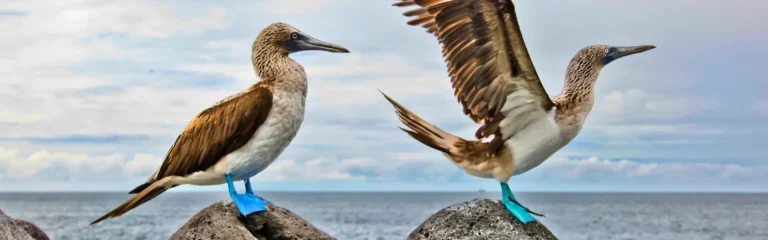
Blue-footed boobies
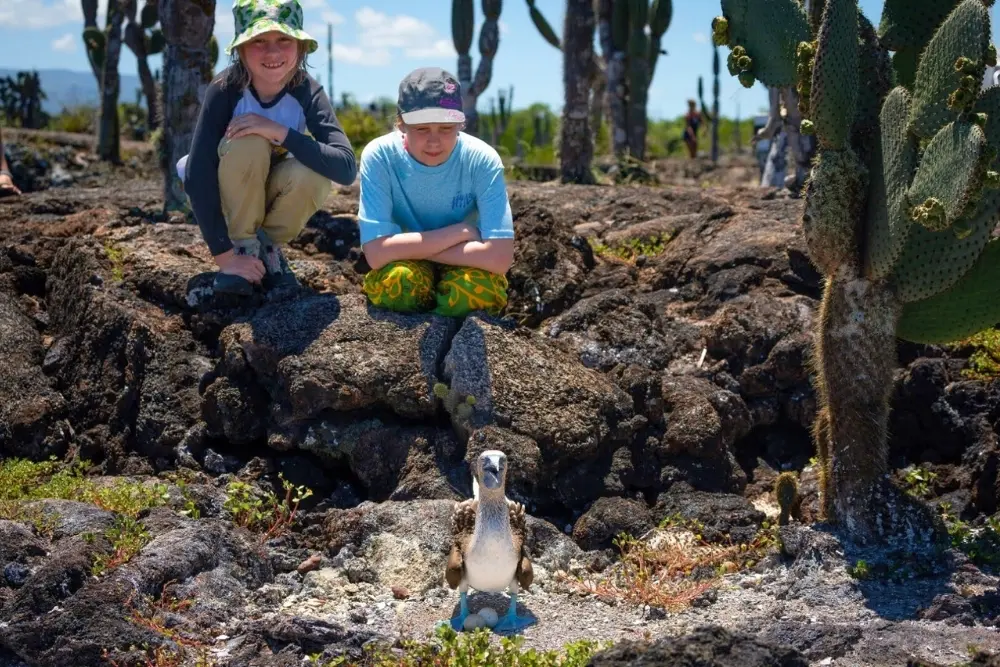
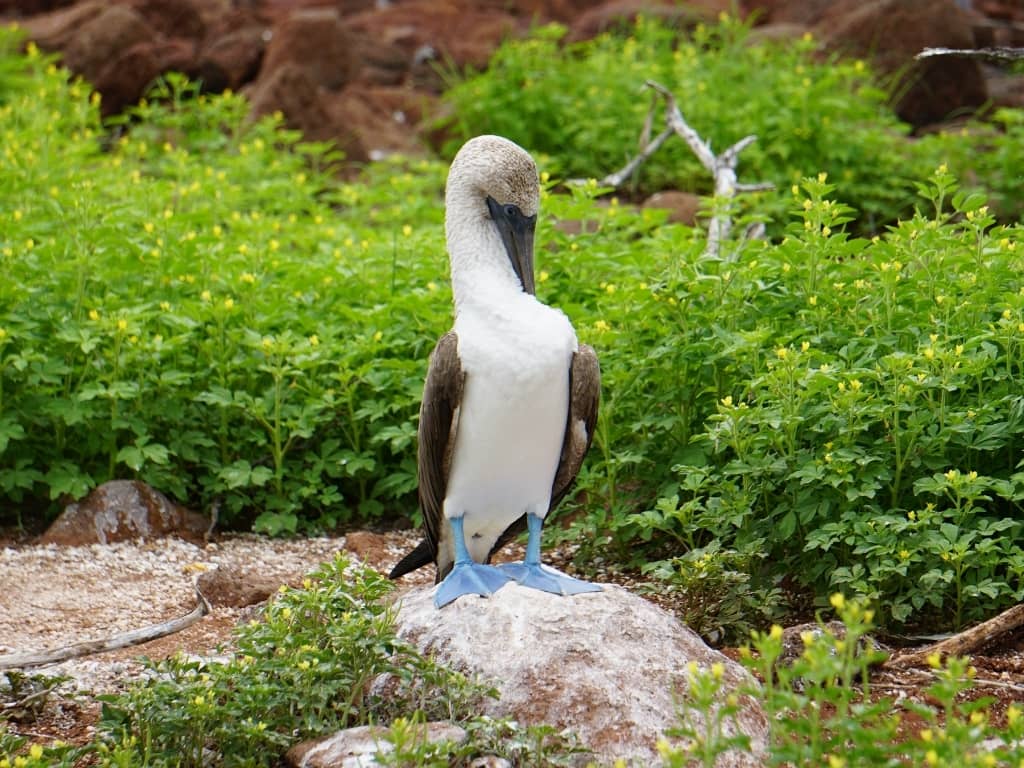
Blue-footed Boobies are large birds, with brown plumage, a rump and black tail, and white underpants. Their blue feet make them very easy to recognize. They are very popular thanks to their colorful turquoise feet.
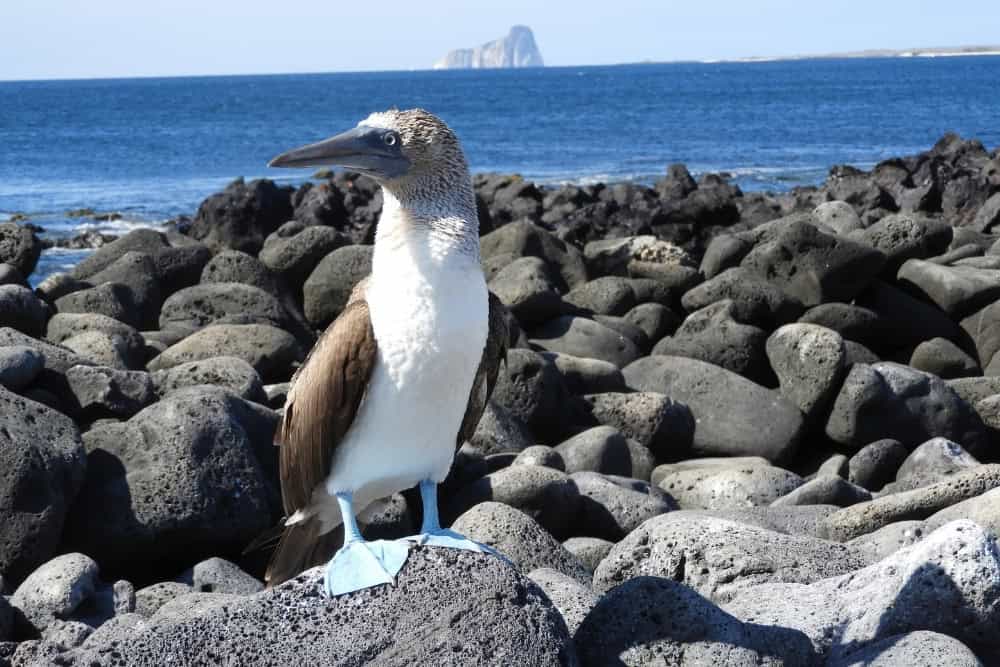
During the courtship, females prefer brighter feet because they indicate the best quality of genes. Also, females tend to be larger than males, with darker blue feet. The courtship dance is very romantic: males prance about, bow, raise their heads, and spread their wings.
Blue-footed Boobies have an amazing ability in water and air. They can spot small fish from the air, and dive at a speed of 60 mph (96.5 kph).
North Seymour Island is the best seabird breeding ground in the Galapagos. You can see Blue-Footed Boobies there, but also on Española, Fernandina, Floreana, Isabela, Pinzon, and Santa Cruz Islands.
Nazca Boobies
Nazca Boobies are white, and they have black feathers on their tails. They can be easily distinguished from Blue-Footed and Red-Footed Boobies thanks to their foot color and masked face. The male’s beaks are yellow and orange. The females, however, have a more pinkish tone. Also, females are larger in size.
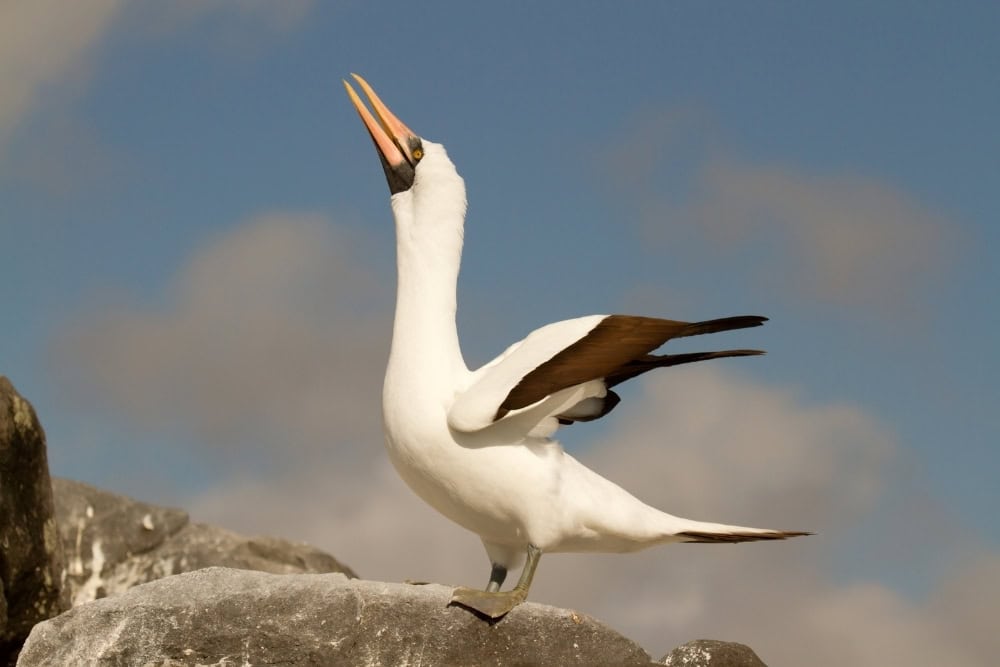
They nest along the ground. They’re the largest of the three. They can be identified thanks to their brilliant white plumage and black-tipped feathers. These types of Boobies can also be found on the Eastern Pacific coastline in South and Central America.
On land, Nazca Boobies can be spotted at Punta Suarez on Espanola Island, Punta Pitt on San Cristobal Island, and on Genovesa Island.
Red-Footed Boobies
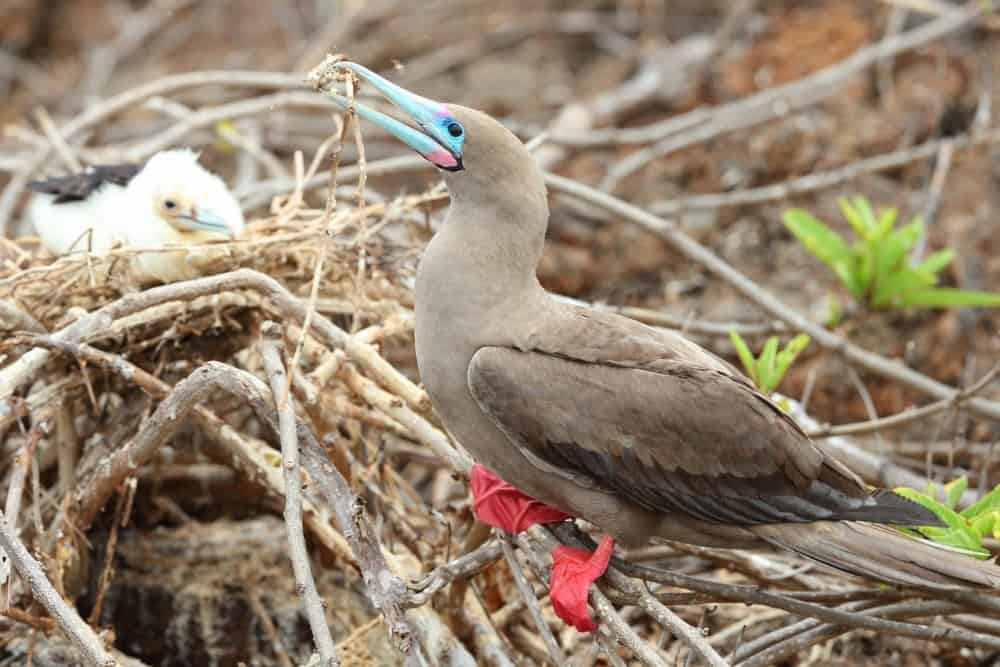
Red-footed boobies are the smallest of all Booby species. They have red legs and feet. Adults have pale bluish bills. In Galapagos, these Boobies have a white belly, rump, and tail. Females and males look the same. However, females are usually larger than males. Males can have a longer tail. They use branches of trees and bushes as nesting areas.
These animals can fly over a distance of up to 93 miles (150 km). They are very skillful in the water, having great diving ability. Red-Footed Boobies are able to catch fish while they dive up to 130 ft (40 m) underwater. They can be spotted on Genovesa Island and Punta Pitt on San Cristóbal Island.
9. Galapagos has tropical Penguins
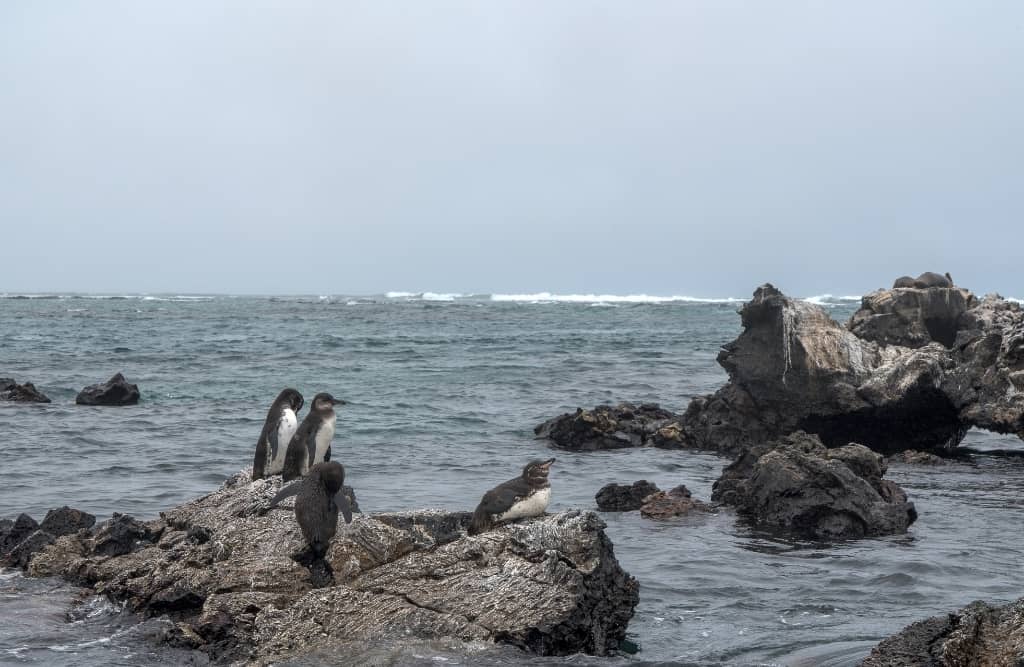
The smallest Penguins in the world live in the archipelago! What are some interesting facts about the Galapagos Penguins? The Galapagos Penguins are endemic to the islands. They live at the Equator and swim in tropical waters. However, the water is cool thanks to the intersection of various marine and air currents. A fun fact about Galapagos is that the islands are the only place in the Northern Hemisphere where you can find Penguins in their natural habitat.
Galapagos Penguins are the smaller penguins in the world. 95% of them prefer to live in the cold, nutrient-rich waters of Fernandina and Isabela Islands. They are occasionally seen on Bartolome, Santiago, and Floreana Island, so you’ll need to take a cruise tour to be able to see them. These animals nest at sea level. You can find them in caves, close to shore, and at shallow depths.
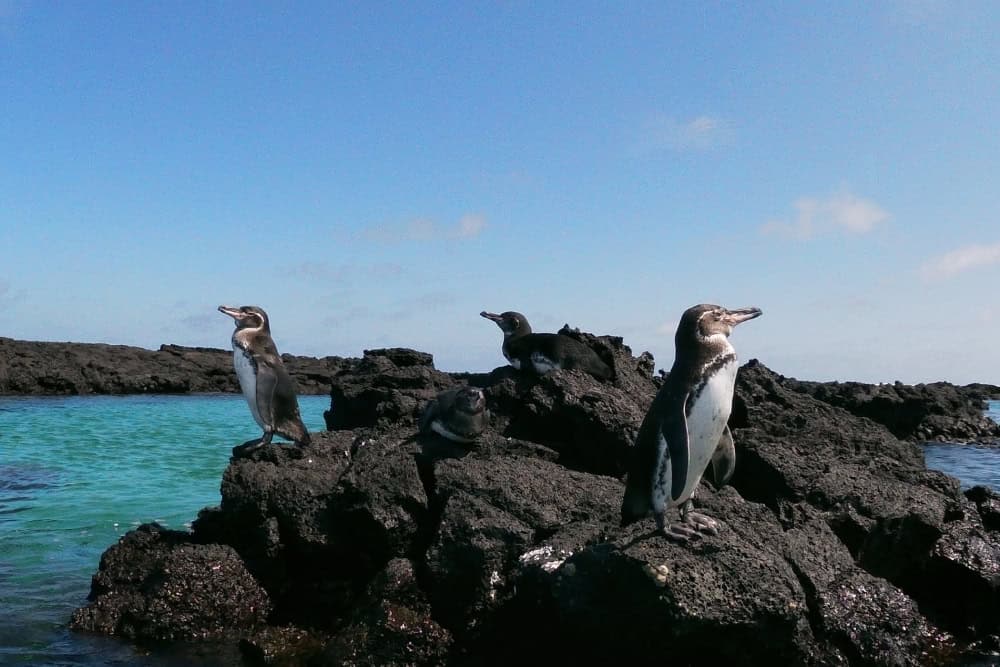
Penguins take advantage of the abundant food that comes from the rich nutrients of the Humboldt currents that arrive from Antarctica. The best moment to see them is during their nesting season, from May to December.
10. Marine Iguanas are unique animals on Earth
Marine Iguanas are very special animals: they are the only sea-going lizards in the world. They enjoy water so much that they learned how to swim. They use their laterally flattened tails as propellers to go through the water. Even so, their sharp claws help them cling to rocks. These swimming lizards are herbivores, and they prefer to feed on algae and seaweed.
They are endemic to the Galapagos. Adult marine iguanas are black. However, males change during the mating season. Even so, they change colors and adopt different colors: shades of green, turquoise, red, and orange. Also, during mating season, males fight for dominance over females.
11. One of the best facts about the Galapagos Islands is that different species of whales migrate to its waters
Whales and dolphins (cetaceans) are the only aquatic mammals that live on the islands. They are covered with a layer of fat that keeps them warm and provides a reserve of energy. For instance, 24 different species of whales have been identified in the Galapagos. Even though they are not endemic to the islands, because of their migratory activity, it’s very likely to see them swimming peacefully in the Marine Reserve.
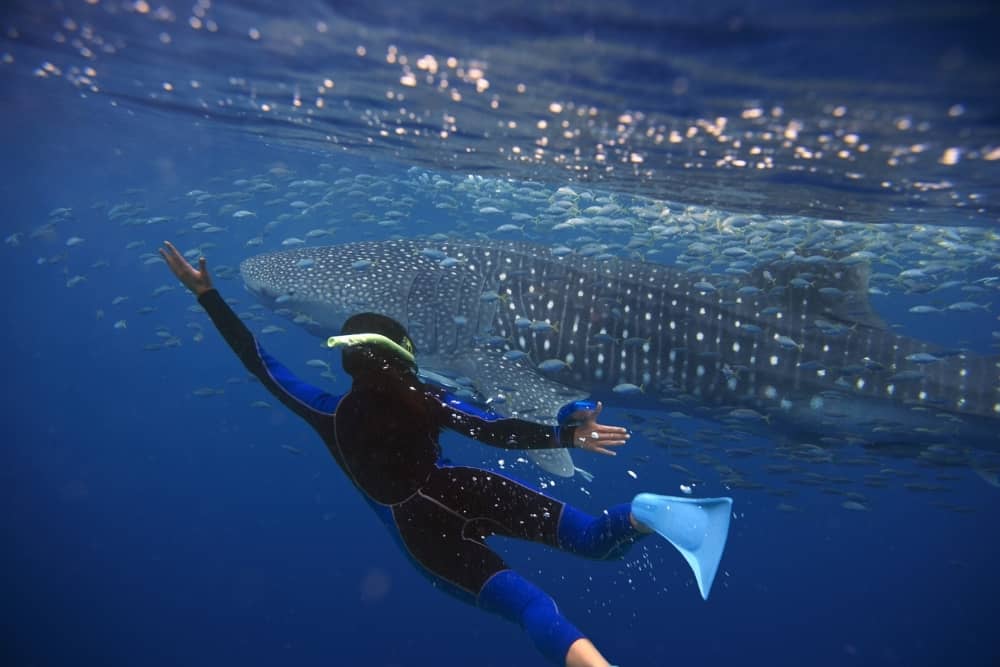
When visiting the Galapagos, and depending on the season, lucky tourists can see different types of whales, such as:
- Humpback Whales
- Sperm Whale
- Killer Whale
- False Killer Whale
- Pilot Whale
- Bryde Whale
It’s easier to see whales if you choose a cruise. Cool facts about the Galapagos include an encounter with a whale dance when you least expect it. Maybe the best place for whale watching is the channel between Isabela and Fernandina Islands. Darwin and Wolf Islands are also great spots to see whales, as well as sharks. When you plan your Galapagos vacation, you might want to look for tours from June to November!
12. Giant Tortoises are the oldest vertebrates walking around Earth
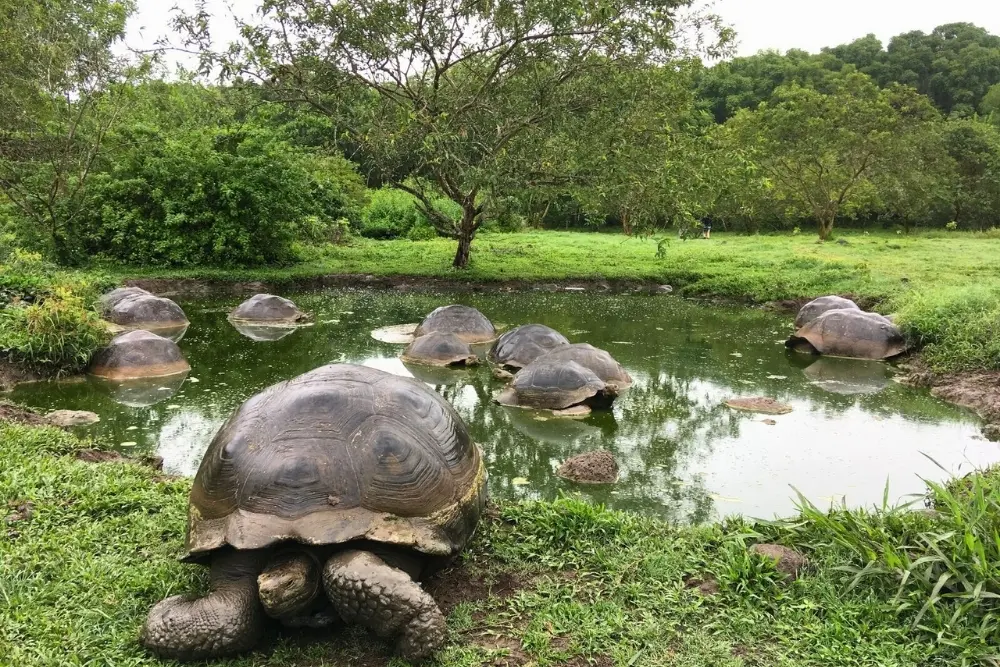
Do you know which animals are the oldest existing vertebrates on the planet? Galapagos Tortoises, of course! The average Galapagos Giant Tortoise lives for over a century, making their longevity the highest of any vertebrate on land. Giant Tortoises hold the record for the longest lifespan of any animal on Earth! They eat cactus pads, grasses, and native fruit. It’s amazing that they can survive for one year without eating food or drinking water.
Around the islands, you can see many subspecies of Tortoises. For instance, the ones that live in places where there’s more rain have “dome” shaped shells. On the contrary, the ones that live in drier conditions have a smaller “saddleback” shell.
Interesting Galapagos Islands are that between the 18th and 19th centuries, Giant Tortoises were so abundant on the Galapagos that pirates, whalers, and sailors captured them for their fat. The animals can survive for months without food or water, so travelers kept them on their ships as a means of fresh protein.
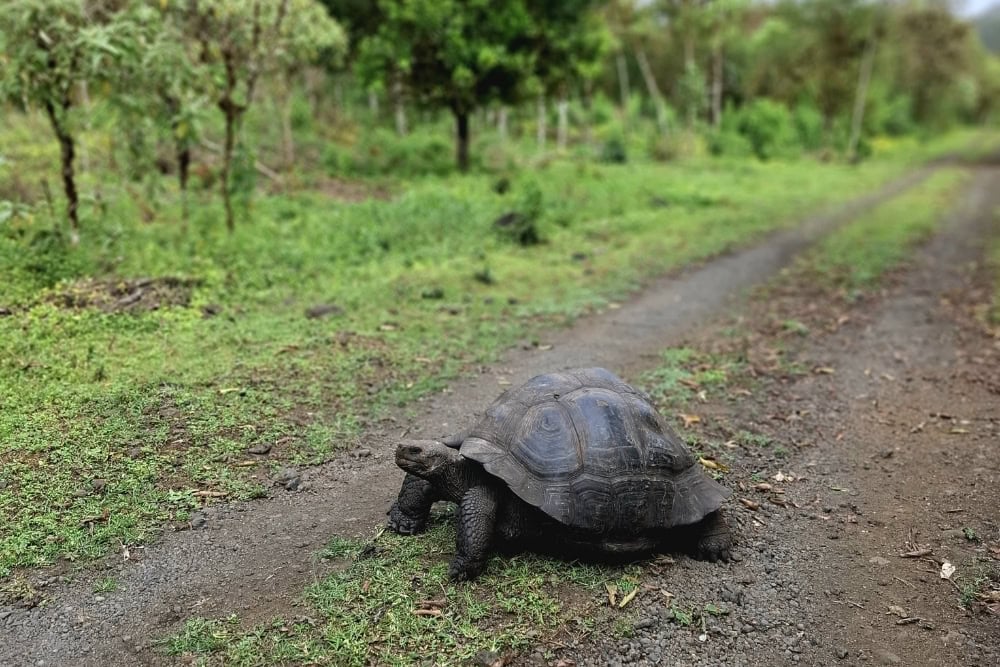
The islands were once home to at least 250,000 Tortoises. However, they almost became extinct and nowadays only 15,000 remain in the wild. Even so, on Floreana and Santa Fe Islands Tortoises went extinct in the mid-1800s.
Ecuador protects Galapagos Tortoises
Today, Ecuadorian law protects the Galapagos Tortoises. Also, the Convention on International Trade in Endangered Species of Wild Fauna and Flora (CITES) prohibits all international trade. Even so, in the past years, the Galapagos Conservancy Fund and the Galapagos National Park have restored Giant Tortoise populations.
13. The Lonesome George was about 100 years old when he died
The mysterious and wonderful life of Lonesome George is one of the best facts about the Galapagos Islands. Did you know that George was the last of his species? Until his death in 2012, he was the sole remaining Pinta Island Tortoise (also known as Chelonoidis Abingdon).
Lonesome George was classified as one of the rarest creatures in the world. Over the years, he became a conservation icon.
In 1971, a Hungarian scientist found Lonesome George for the first time. A year later, Galapagos National Park took him into captivity at the Tortoise Center on Santa Cruz Island. Lonesome George didn’t find a breeding partner and had no offspring.
The world mourned Lonesome George’s death
In June 2012, Lonesome George was found dead in his corral at the Tortoise Breeding and Rearing Center on Santa Cruz Island. A Galapagos National Park ranger, Fausto Llerena, found George.
Llerena was part of the expedition that discovered George on Pinta Island. Over the years, he became the giant tortoise’s caretaker. Lonesome George’s age is unknown, but it was estimated at more than 100 years old. He died of natural causes. However, his passing was a shock for scientists due to his young age. Giant Tortoises can live up to 200 years old!
The Ecuadorian government and the Natural Museum of Natural History of New York embalmed George. You can visit Lonesome George and learn with him while touring the same Santa Cruz Island!
14. Green Sea Turtles are peaceful swimmers
Around the world, Green Sea Turtles live in tropical and subtropical waters around the Pacific Ocean. Actually, in the Galapagos, they nest and swim around the islands. The best facts about the Galapagos Islands are that you can easily spot sea turtles on snorkel tours and cruise trips.
Maybe you didn’t know that adult Green Sea Turtles are vegetarians. Juveniles eat almost anything. Also, females lay their eggs at night to avoid predators. They pass the sea’s high tide mark and prepare a nest with their flippers. Normally, they lay between 50 and 200 eggs before they go back to the ocean as the sun rises.
By the way, Green Sea Turtles are not social animals. They prefer to stay alone, as they don’t care for their offspring, don’t form migratory groups, and prefer not to interact with other animals. However, during the nesting season, males and females interact with each other. That’s why, if you want to see pregnant female Green Sea Turtles around the shore, you should book your tour from December to March.
15. Galapagos’ flora and fauna inspired Charles Darwin’s theory of evolution
When Charles Darwin visited the Galapagos Islands, he was instantly mesmerized. Even so, he was so inspired by the animals that he took samples of species. He continued his studies and observations after he left Galapagos.
Which Galapagos Island did Darwin visit?
Charles Darwin embarked on the HMS Beagle ship and spent five years on a scientific expedition. In September 1835, while the ship was on the return route across the Pacific, Darwin arrived at the Galapagos Islands. First, the scientist disembarked on San Cristóbal Island. Then, he visited Floreana, Isabela, and Santiago Islands. Thus, Darwin spent only five weeks on the Galapagos, and he was 26 years old upon his arrival.
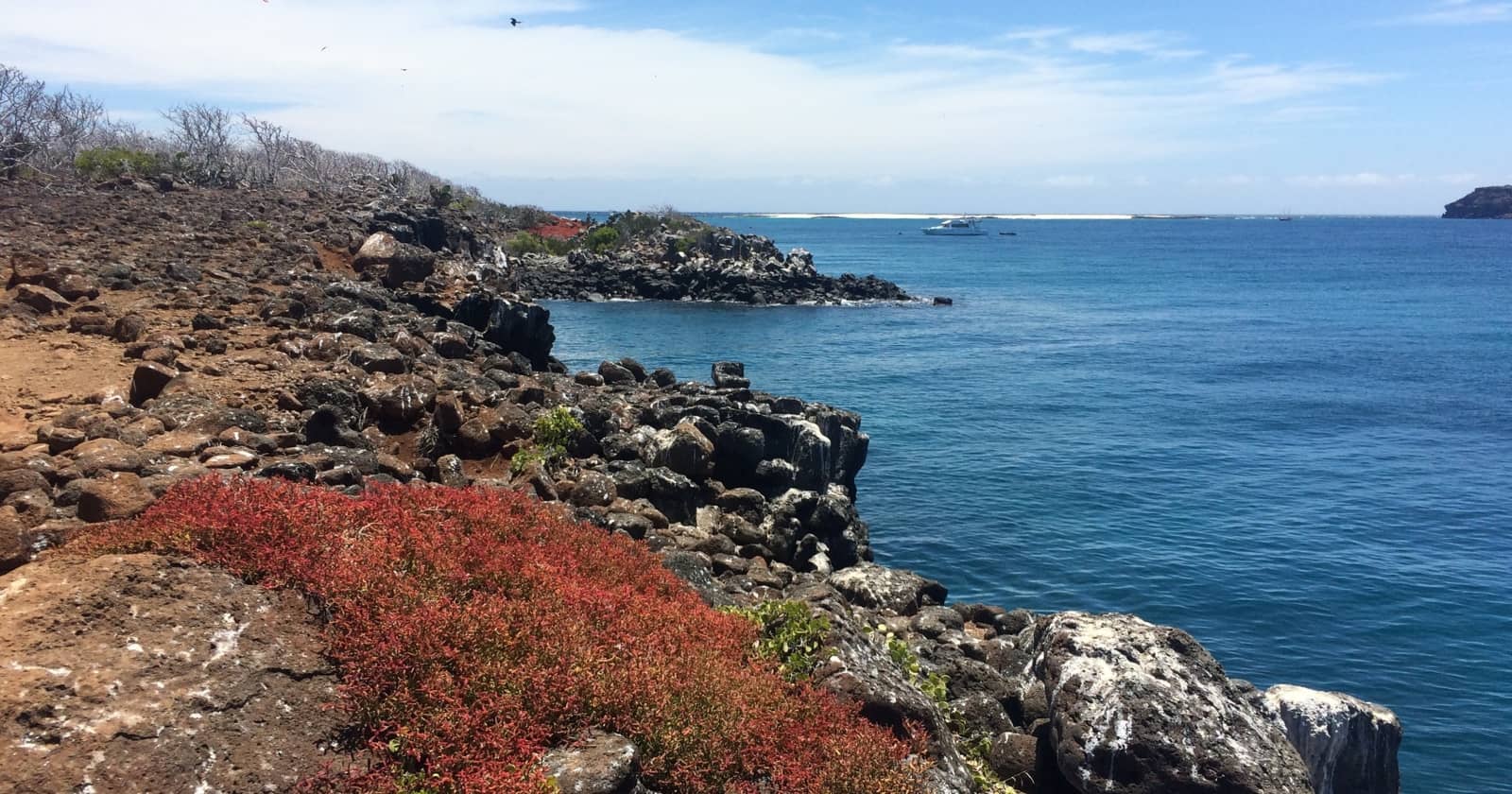
Captain Robert FitzRoy and his officers worked on their maps and charts. On the other hand, Darwin collected geological and biological specimens. He closely observed species such as the Galapagos Mockingbirds and the Giant Tortoises from different islands. The scientist was a great observer, therefore he located significant variations in birds, plants, and other species.
One of the best facts about the Galapagos Islands is that animals showed Darwin that species change over time
In 1859, 24 years after visiting the Galapagos, Darwin published his findings in On the Origin of Species. Moreover, the book had instant recognition. In his book, the scientist suggested that species change over time by natural selection. Further, he based his theory on the analysis of the plants and animals he gathered during his trips.
According to Charles Darwin, natural selection shows that “species are more likely to survive in their environment and pass on their genes to the next generation when they inherit traits from their parents that are best suited for that specific environment.” His work is a stepping stone in understanding life.
According to Darwin, Galapagos “seems to be a little world within itself.” Thanks to Darwin’s natural selection theory, Galapagos is worldwide famous as a wildlife inspiration. Even so, the Archipelago is a symbol of ecological preservation.
Nowadays, when you book a tour of the Galapagos Islands, you can follow Charles Darwin’s footsteps and see the difference between its incredible endemic species!
16. Who discovered the Galapagos Islands?
Fray Tomás de Berlanga, a Dominican friar and Bishop of Panama, is the official “discoverer” of the Galapagos Islands in March 1535. He described his first encounter with the islands to the King of Spain as a “dross, worthless because it has not the power of raising a little grass, but only some thistles.”
Some interesting facts about the Galapagos Islands are that Berlanga highlighted the number of cacti in inhospitable terrain and the difficulty of finding water on the islands. The bishop described how the tide seemed to disappear due to the mist and fog. As a result, he called them “enchanted”.
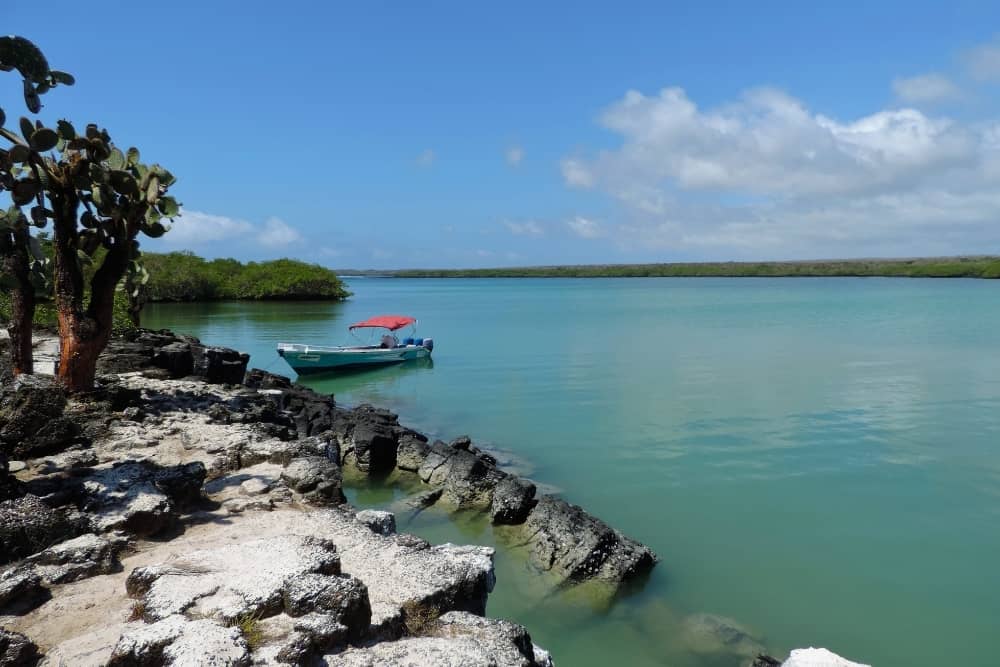
Cool Galapagos Islands facts are that pirates hid their loot in the archipelago
The Galapagos Islands were a hideout for buccaneers, sailors, and whalers. Even Sir Francis Drake used to wander through the islands. Its strategic location was a perfect refuge to stash pirate loot. However, its inhospitable terrain discouraged visitors from permanent settlements.
In the 17th century, Galapagos was part of the Spanish trade routes. On the equator, the islands were strategically located: the distance from the mainland was an advantage for urgent escape, but close enough for commercial journeys. Also, pirates and buccaneers used the islands as a source of food. They preferred giant tortoises’ meat, which helped them survive throughout their never-ending adventures.
Galapagos appeared on a map in the 17th century
William Ambrosia Crowley, a buccaneer that visited the Galapagos Islands during his circumnavigation of the world, published the first chart of the islands in 1684. At the same time, the pirate William Dampier described the Galapagos in his published work A New Voyage Round the World in 1697. He coined some terms we used until now. For instance, he included the word “sea lion” for the first time!
The first inhabitant of the islands was an Irishman
One of the best facts about the Galapagos Islands is that Patrick Watkins, an Irish sailor, was the first settler of the archipelago in 1807. He was abandoned on Floreana Island. He was able to grow vegetables. Further, rumor has it, drank exclusively the rum he traded with boats that stopped at the coast. Two years later, Watkins was able to flee the island by stealing a boat and navigating to Guayaquil, a coastal city in Ecuador.
17. Galapagos is a year-round destination
The amazing thing about the Galapagos Islands is that you can plan your vacation any time of the year! Located along the equator, the archipelago is a year-round destination. Likewise, it has a temperate climate, with two marked seasons:
Hot season (December through May)
Rain and sun characterize the hot season. During the warm and wet season, tourists will find bright sunlight, lush vegetation, and an intermittent mist or refreshing drizzle.
Overall temperatures:
- Land: avg. 72-86°F/30°C.
- Water: avg.76°F/25°C.
Dry season (June through November)
During the dry season, tourists can expect cloudy skies, cooler temperatures, and dry weather. The season is neither too hot nor too cold, making it ideal for adventure excursions. Also, tourists will find misty rain. Throughout the dry months, the ocean waters are nutrient-rich thanks to the Humboldt Current. This increases marine activity!
Overall temperatures:
- Land: avg. low/high 66-79°F/19-26°C.
- Water: avg. 72°F/22°C.
Any time of the year is great to visit the Galapagos
Depending on the season, Galapagos is either lush, green, and tropical, or barren and arid. However, you should know that because of its location, the archipelago isn’t a Caribbean tropical destination. What makes the islands so special and some cool facts about the Galapagos Islands are the volcanic moonscapes, deserted islands, and unique wildlife on land or at sea.
There’s no “best” or “worst” time to plan your Galapagos Islands vacation
When you plan your Galapagos Islands travel and tours, make sure to determine what kind of activities you want to do and what fauna and flora you want to see. In the islands, there are certain months that fit your wishes better.
For instance, the best time to see land species is during the warmer months (December through May). On the contrary, during the dry season (June through November), there’s an intense marine activity, perfect for snorkeling and scuba diving.
18. Daylight and night skies are a privilege in the Galapagos
Ecuador is a perfect destination because days and nights are of equal duration. Due to its location on the equator line, there are 12 hours of daylight and 12 hours of nighttime, all year. As a result, one of the best facts about the Galapagos Islands is that there’s no need for daylight savings. Therefore, the chances of watching diurnal and nocturnal wildlife increase.
Galapagos timezone is UTC/GMT -6 (one hour earlier than in Ecuador mainland).
Stargazing in the Galapagos
When you look at the sky in the Galapagos, you can see a mind-blowing display of the universe. The islands are an astronomy hotspot. Also, its location on the equator allows visitors to see constellations and stars from the Northern and Southern hemispheres.
A fun fact about the Galapagos is that it lies on either side of the equator line! The islands consist of 7880 km² (3040mi²) of land spread over 45,000 km² (17000 mi²) of the ocean.
19. Galapagos has 5 inhabited islands
Are Galapagos Islands inhabited? Yes! Today, more than 25,000 people live in the five inhabited islands: Santa Cruz, San Cristóbal, Isabela, Floreana, and Baltra (Seymour). Only 3% of the islands have human settlements. The other 97% remaining is a national park.
The migration started in the 1960s. Nowadays, the population accounts for less than 0,15% of the total population of Ecuador.
As part of Ecuador, the official language is Spanish. However, you can find tour guides fluent in English, French, German, and other languages.
20. One of the cool facts about the Galapagos Islands is that it had many names before Ecuador established its official identity
The official name of the Galapagos Islands is Archipiélago de Colón. Its name is an honor to the explorer Christopher Columbus (Colón being his Spanish name). Even though he never visited the islands, the Ecuadorian government decided to name the islands after him in 1892, on the 400th anniversary of his voyage to the ‘New World.’
Galapagos had many names before the Ecuadorian government took ownership of the islands in 1832. Thus, sailors called them Enchanted Islands because they seem to “appear and disappear” into the mist.
Moreover, the word “Galapagos” came from galápago, or the Spanish word for a horse saddle, as it looks like Giant Tortoises are wearing saddles. In 1570, the Flemish cartographer Abraham Ortelius included the Galapagos on the world atlas for the first time. He named it “Insulae de los de Galapagos.”
21. Floreana Island has a post office service
Post Office Bay is Floreana Island’s unique postal service. It was a wooden barrel with no stamps, walls, or ceiling. Back in the 18th century, whalers set up a post office where ships frequently passed through. A whiskey barrel eventually became an ingenious communication channel.
Sailors left their letters on the barrel and, at the same time, checked if there were some others they could deliver. Thus, whalers preferred the island because it was a pit stop for fresh water and food. Did you know that Floreana has one of the few freshwater sources in the Archipelago? Also, sailors took tortoises for their meat.

Leave a postcard in Floreana’s post office and discover one of the best facts abotut the Galapagos Islands
If you plan a tour to Floreana Island, make sure to leave your own postcard on its Post Office Bay. You don’t need a stamp, just write down an address and hope for the best!
Moreover, you can be part of the sailors’ tradition of delivering correspondence: if you find an address close to your hometown, take it with you and deliver it yourself!
22. Interesting fact about the Galapagos is that the islands had a transcendental role in World War II
Galapagos became a strategic point in the Pacific Ocean. Furthermore, the United States Army Air Force used the islands as a cardinal site to guard the Panama Canal. Even so, in 1911, the US wanted a 99-year lease of the Archipelago for US$ 15 million. Thankfully, former President Eloy Alfaro declined the offer.
Baltra Military Base
Once World War II started, the US government offered Ecuador the option to rent the islands as a military base. The US government started building the Baltra Military Base in 1942. Moreover, Galapagos was part of a geographical triangle of bases, with the others being in Salinas (in mainland Ecuador), and Nicaragua. The Americans used to patrol the ocean for enemy submarines.
In 1943, Galapagos became home to almost 5,000 new men. It grew into the largest colonization of the island, due that up until then the island had 810 people living there. Of course, the arrival of the American soldiers increased the demand for water, food, and services.
23. You can only get to the Galapagos Islands by plane
The only way to access the Galapagos Islands is by plane. However, there are no international flights that go to the Galapagos. Also, there’s no service for boats, cargo ships, or any time of cruise from Ecuador or any other ports. Also, there are no bridges for ground transport.
The archipelago is located 1.396 km (609 miles) away from the continent. So, you need to get to the mainland first. Ecuador has two major international airports:
- José Joaquin de Olmedo International Airport (airport code: GYE), located in Guayaquil.
- Mariscal Sucre International Airport (airport code: UIO), is located in Quito.
Therefore, you can start your trip from Quito or Guayaquil. In both cities there are many things to do, so you can start your vacation by touring around Ecuador first.
Baltra Airport
A cool fact about the Galapagos is that Seymour Galapagos Ecological Airport (airport code: GPS), in Baltra Island, works 100% with renewable energy. 35% of the energy comes from photovoltaic systems, and 65% from wind turbines. To get to Santa Cruz Island, you can take a water taxi, and then a bus or private transfer.
San Cristóbal Airport
The second airport is San Cristóbal Airport (airport code: SCY), located on San Cristóbal Island. It’s 10 minutes away from the city.
Galapagos inter-island transportation
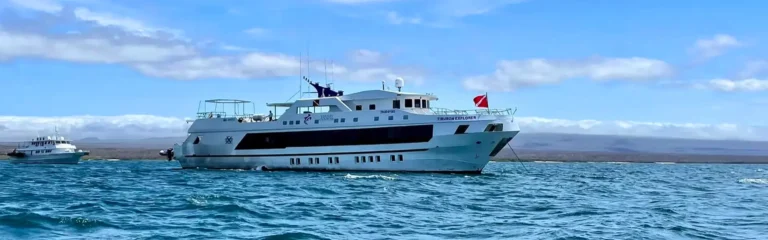
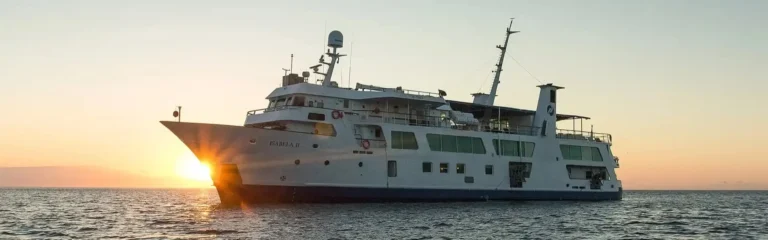
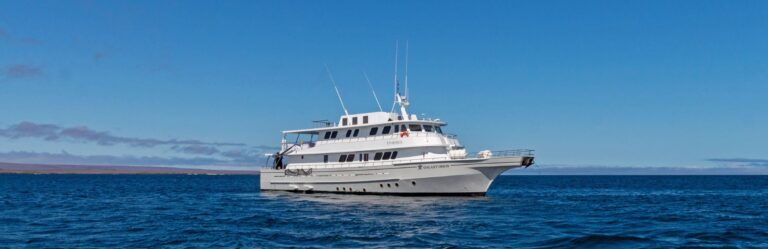
A great way to experience the Galapagos Islands is by island hopping! You can choose from speed boats or planes.
Speedboats
Speedboats have a capacity of 20 to 40 passengers. On average, the trip is a 2.5-hour journey. There are 2 routes: San Cristóbal – Santa Cruz, and Santa Cruz – Isabela.
Airplanes
For inter-island flights, they’re normally one or two planned flights per day between Baltra, San Cristóbal, and Isabela Islands. Depending on the route, the flight duration is about 30 to 45 minutes. The airplanes have a capacity of 6 to 9 passengers.

24. One of the best facts about the Galapagos is that scuba diving is a mind-blowing experience!
Galapagos has about 30 diving sites to offer. Therefore, scuba diving is on every diver’s bucket list! When you jump into the ocean, you’re up for an amazing experience. However, seeing wildlife is never 100% sure. It depends on weather conditions, the location, etc. But, in general, you may see marine iguanas, sea turtles, sharks, sea lions, and dolphins, among many others.
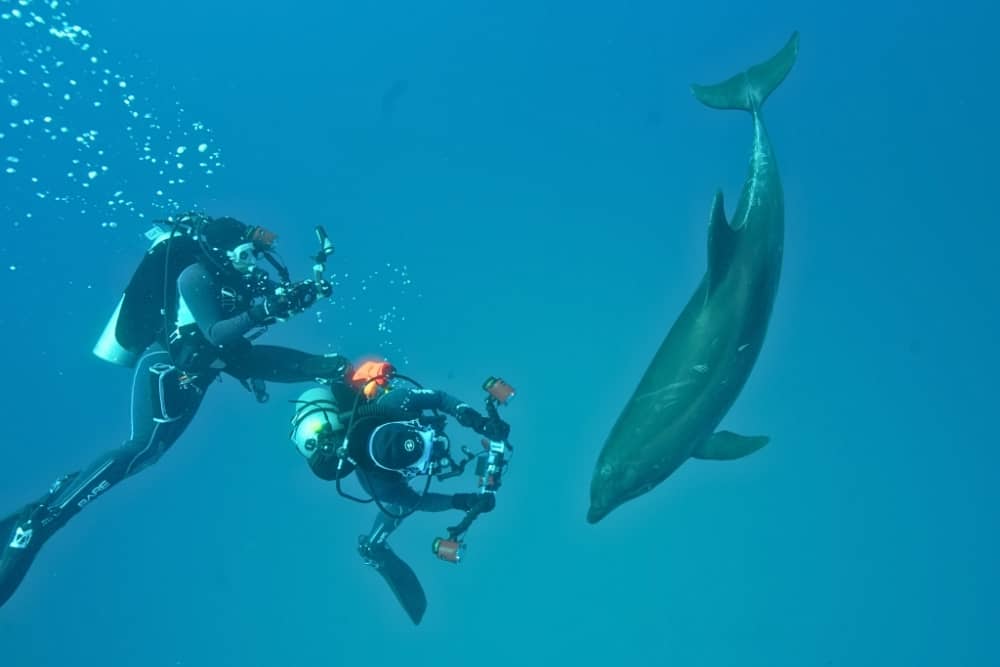
Remember that 20% of the marine life of the Galapagos is endemic, so you’ll be able to encounter species unique to the islands. Other popular activities include:
- Snorkeling
- Hiking
- Sea kayaking
- Surfing
- horseback riding
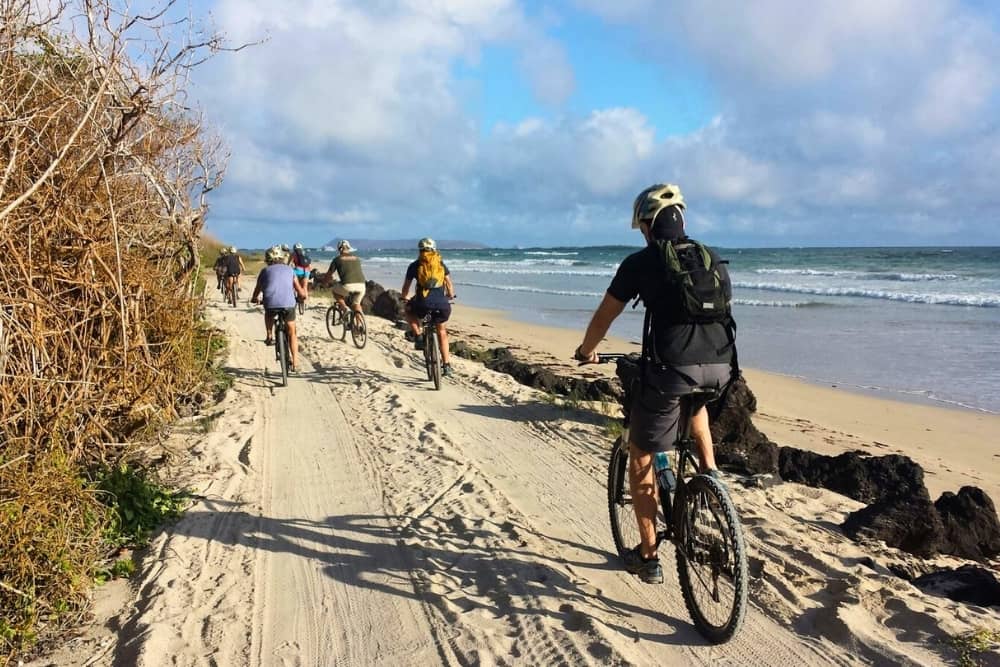
- Mountain biking
25. Other fun facts about the Galapagos Islands
Movies
Did you know that the movie Master and Commander was filmed on Bartholomew and Santiago Islands? Famous actors such as Russell Crowe, Paul Bettany, and James D’Arcy visited the islands.
The classic movie The Old Man and the Sea (1958) was also filmed in the Galapagos. Also, there’re many documentaries produced and filmed on the islands:
- The Galapagos Affairs: Satan Came to Eden
- Galápagos
- Galapagos: Hope for the Future
- The Empress of Floreana
Books
If you’re looking for adventure books for your vacation, maybe you should check the one that has the Galapagos as part of its scenario! Some titles are:
- Las Encantadas, or Enchanted Isles (1854): written by American author Herman Melville. It’s based on Melville’s travels on the islands.
- Galapagos (1985) by Kurt Vonnegut: a science fiction novel set one million years in the future.
- Beyond the Islands (1980) by Alicia Yánez Cossío: magic realism novel about eight people who travel to the Galapagos.
There is Much More to Learn
How many of these 25 remarkable Galapagos Islands’ fun facts did you know? If you want to know more about the magical Archipelago and want to book a tour with Rebecca Adventure Travel, one of our Destination Experts will be happy to help! In addition, if you need more information regarding when to travel to Galapagos or Ecuador, you can contact us.
Further Reading
- Top 5 Family Haciendas around Quito for a Weekend Getaway
- Can you visit the Galapagos Islands on a budget?
- The Best Restaurants in the Galapagos Islands
Frequently Asked Questions
What is the significance of the Galapagos Islands?
The Galapagos Islands are a globally significant biodiversity hotspot, renowned as the place where Charles Darwin developed his theory of biological evolution. They are home to a high percentage of unique, endemic species not found anywhere else in the world.
How were the Galapagos Islands formed?
The islands were formed by volcanic activity and are constantly changing due to ongoing geological processes. This formation is a key reason for the unique and diverse ecosystems found on the islands.
What are some of the unique species found in the Galapagos?
The Galapagos are famous for their unique wildlife, including species like the marine iguana (the world’s only swimming lizard), Darwin’s finches, and the Galapagos penguin (the only tropical penguin species).
What makes the Galapagos a popular destination for divers?
The islands are a popular destination for scuba diving due to the convergence of three major ocean currents in the area. This unique natural phenomenon brings a wealth of marine life, making it a ‘mind-blowing’ experience for divers.
How are the Galapagos Islands protected?
The Galapagos Islands are heavily protected as a national park and have been designated a UNESCO World Heritage site. These protections are in place to preserve the unique flora and fauna for future generations.
Galapagos Tours